
Welcome
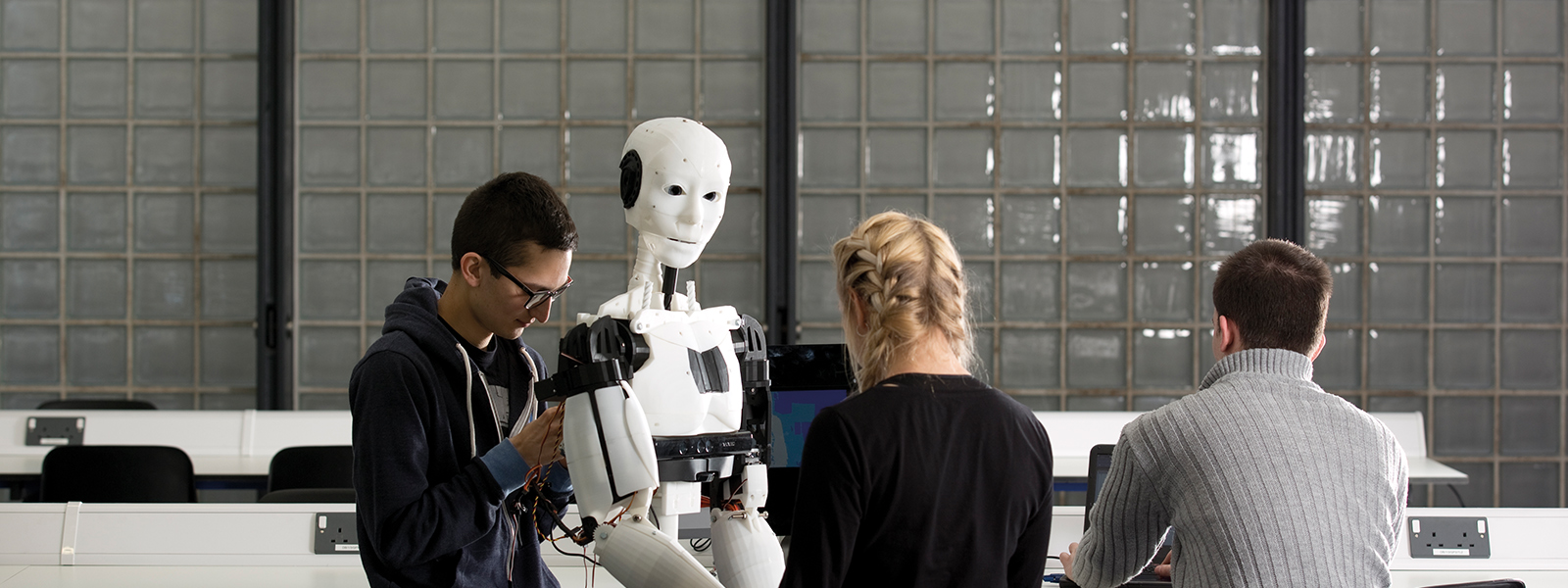
The School of Computer Science (SoCS) has a rapidly growing international reputation for its research. We pursue a blend of fundamental, applied and interdisciplinary research and have particular strengths in computer vision, robotics and autonomous systems, and human computer interaction.
The research carried out by students and academics in the School of Computer Science is ground-breaking. In the most recent external Research Assessment carried out nearly two-thirds of our staff’s publications were rated as being of “international quality” or “world leading”. That is another fantastic achievement for a relatively new school, and it clearly vindicates our strategy to accommodate a rapid growth supported through the expertise of our staff and academics.
Our highly-active research centres feature world-leading developments in computer vision and in robotics and autonomous systems. We also have strong links to many industrial collaborators and other universities around the world. We always try to incorporate our research findings into our taught curriculum wherever possible and under the banner of “student as producer” we give all students opportunities to get involved in this cutting-edge and exciting work.
We believe all of this makes the School of Computer Science at the University of Lincoln a truly great and exciting place to study and develop, and we look forward to working with you towards the next stages of your life.
LINCOLN CENTRE FOR AUTONOMOUS SYSTEMS (L-CAS)
 L-CAS specialises in perception, learning, decision-making, control and interaction for autonomous systems, such as robots, and the integration of these capabilities in applications including personal robotics, healthcare, agri-food, security, and intelligent transportation.
LABORATORY OF VISION ENGINEERING (LoVE)
 Specialises in the capture, transmission, processing and understanding of image, video and other high-dimensional data. The Centre focuses on several application areas, including healthcare, scientific, security and environmental monitoring.
INTERACTIVE TECHNOLOGIES LAB (intLab)
 The intLab at the University of Lincoln establishes quality of life as its central concern, aiming to promote better living through, and with, technology. Research interests range from human-computer interaction, games and wellbeing, to sustainability, critical design, and fine art.
MACHINE LEARNING GROUP (MLEARN)
 The MLearn Group will specialise in artificial and computational intelligence, focused on the design, development and study of machines that are able to reason, predict and adapt to changing environments, and assist humans in their activities and interactions.
Lincoln School of Computer Science, University of Lincoln, Brayford Pool, Lincoln. LN6 7TS
email: enquiries@lincoln.ac.uk
tel: + 44 (0)1522 886644